Exploring the Introduction, Principle and Working of DC Motors
Definition and Purpose of DC Motors

DC motors are electromechanical devices that convert electrical energy into mechanical motion. They operate on the principle of electromagnetism and are widely used in various industries for their ability to provide efficient and controllable rotational motion. Unlike AC (alternating current) motors, which rely on changing magnetic fields, DC motors rely on a direct current power source.
Principle of DC Motor
Direct Current (DC) motors are electrical devices that convert electrical energy into mechanical motion. Due to their efficiency, reliability, and controllability, they are widely used in various applications, ranging from industrial machinery to household appliances. DC motors operate based on fundamental principles of electromagnetism and the interaction between magnetic fields and electric currents.
Electromagnetism and Magnetic Fields
Electromagnetic Induction
Michael Faraday discovered that DC motors operate on the principle of electromagnetic induction. According to Faraday’s law, a changing magnetic field induces an electromotive force (EMF) or voltage in a conductor. In a DC motor, a voltage is applied to the armature (rotating component) through brushes and a commutator. As the armature rotates within the magnetic field produced by the stator (stationary part), an EMF is induced, causing current to flow through the armature windings.
Basic Components of DC Motors
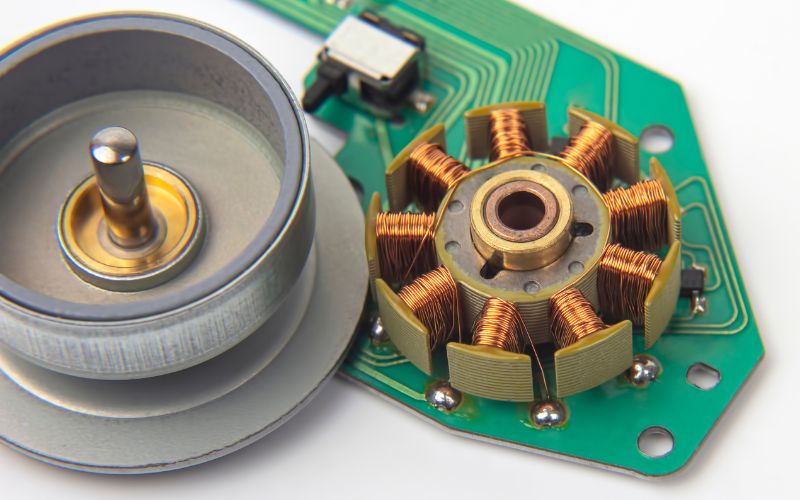
Working on DC Motor
The working of a DC motor is an intricate interplay between magnetic fields, electrical currents, and mechanical motion. By harnessing the principles of electromagnetism, DC motors transform electrical energy into mechanical power, enabling a wide range of applications across industries.
Basic Structure and Configuration
DC motors are designed with a specific structure and configuration. The stator provides the stationary magnetic field, while the rotor carries the armature windings. Depending on the type of DC motor, the stator can contain field windings or permanent magnets, while the rotor may have a core or be made up of individual conductive coils.
DC Motor Operation
Beneath the surface of a DC motor lies a captivating process of energy conversion and mechanical motion. When a direct current is supplied to the motor, it flows through the armature windings, generating an electromagnetic field. This field interacts with the stator’s magnetic field, resulting in the production of a rotational force.
Commutation Process

The commutation process is crucial for the proper functioning of DC motors. It involves reversing current flow in the armature windings as the rotor rotates. The commutator and brushes ensure the recent changes in direction at the appropriate timing, allowing continuous rotation and maintaining torque production.
Conclusion
In conclusion, delving into the principle and working of DC motors has revealed a world of electrifying mechanics and ingenuity. By harnessing the power of electromagnetism, DC motors transform electrical energy into mechanical motion, enabling countless applications in various industries. Understanding the principles of magnetic fields, commutation, and torque generation has given us the knowledge to design and optimize these motors for efficiency and performance. DC motors, from small appliances to electric vehicles, are vital in our modern lives. As we continue to advance in technology, further research and innovation will undoubtedly lead to even more efficient and powerful DC motors. Exploring the intricacies of these motors not only deepens our understanding of electromechanical systems but paves the way for exciting advancements in automation, robotics, and renewable energy. The principles and working of DC motors will continue to drive us forward, propelling us into a future where electric motion is the beating heart of our technological advancements.